


CONTENTS
This School Guidebook provides general guidance for parents and students enrolled at Hawai‘i Technology Academy. HTA is a public charter school governed by its own board and overseen by the Hawai‘i State Public Charter School Commission. While HTA operates independently from the Hawai‘i State Department of Education, it follows state laws and policies set by the Hawai‘i State Board of Education. This guide is intended as a resource for families and students and is subject to change throughout the school year.
Learning Coaches are required to review the School Guidebook at the start of each school year. You will be prompted to sign your agreement to all policies within HonuHub.
HTA 101
Mission & Vision


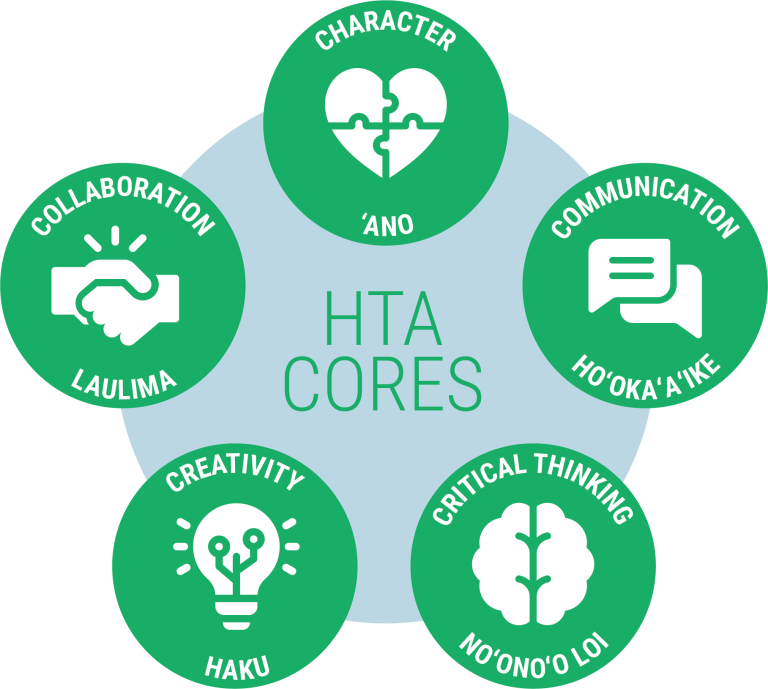
Our 5 Cores
HTA staff/contacts
ADMISSIONS & ENROLLMENT
Admissions policies
HTA’s Admissions & Lottery policy and Enrollment policies guide our annual intake of new and returning students.
Health policy & school health requirements
Hawai‘i State Law requires all students to meet physical examination, immunization, and tuberculosis clearance requirements before they may attend a childcare facility, preschool, or public/private school in the state. The required documents were provided as part of the HTA enrollment or re-enrollment process. Beginning July 1, 2020, additional immunizations were required for students entering childcare or preschool, kindergarten, Grade 7, and post-secondary schools, and for all students entering school in Hawai’i for the first time, regardless of age. The updated immunization requirements conform with current national recommendations and reflect what occurs in healthcare provider offices and clinics in Hawai’i as standard medical practice.
Physical Examination
Must be performed by a U.S. licensed physician, APRN, or PA, and must be completed within one year before:
• First date of attendance at a childcare facility, preschool, or school in Hawai‘i; and
• First date of attendance in Grade 7.
Immunizations
Immunizations are required for childcare facilities and school attendance. Required immunizations depend on the age of the child (childcare or preschool) or grade of the student. All immunizations must meet minimum age and interval requirements between vaccine doses.
For more information about Hawai‘i’s immunization program or the immunization requirements for school entry, please visit the health department website.
Tuberculosis (TB) Clearance
For information regarding TB clearance requirements for school attendance, talk to your child’s healthcare provider or call the DOH Tuberculosis Control Branch at (808) 832-5731 or visit health.hawaii.gov/tb.
What is required by the first day of school?
By the first day of school, all students entering school in Hawai‘i for the first time must have:
1. A completed health record form to document that a physical examination was performed within one year before school entrance and that all immunization requirements have been met.
OR
An appointment notice from a healthcare provider for your child to complete the physical examination or immunization requirements.
AND
2. A completed Tuberculosis (TB) clearance form.
Students who have not completed these requirements by the first day of school will not be allowed to attend school until these requirements are met. Furthermore, if HTA has not received immunization records for a student and/or a student is not compliant with Hawai’i’s immunization requirements by October 15, the student will be withdrawn.
Student fee
The $45/student Student Fee helps cover the cost of basic classroom supplies, single-use academic supplies, curricular software and materials, and an HTA T-shirt. After fully enrolling and at the start of each school year thereafter, you will be prompted to pay the fee in HonuHub via PayPal.
Families who complete HTA’s Application for Reduced Fees may qualify to have this fee subsidized. The student fee is fully refundable should you choose to cancel your child’s enrollment at HTA before the first day of school.
Please note: The Student Fee must be paid before participating in the Computer Loan Program. In addition, students will not be able to participate in extracurricular activities such as Field Studies, dances, retreats, grad night, prom, etc., until payment is received, nor will they be able to use an on-site loaner computer should the student forget his/her laptop.
Student/family records
Student records are maintained between the HTA Registrar’s office and HTA educators. Parents/legal guardians should check HonuHub for current grades and to retrieve copies of student progress reports, report cards, and unofficial transcripts.
Records/transcript requests
Request an official transcript for grades 9-12
Request records for grades K-12
There is a nominal fee payable via PayPal. Please allow up to 10 business days for processing.
If a student transfers from HTA to another school, the new school must contact HTA to make the official records request.
For all other student record updates and/or changes, please contact our registrar’s office at registrar@myhta.org.
Family contact information
Parents/legal guardians are responsible for keeping contact information current within the account section of HonuHub.
When logged into your HonuHub account, you can use these links to:
Update your address
Update your email and phone number
(Alternatively, from your HonuHub dashboard, click on Family & Account > Family Accounts.)
(Alternatively, from your HonuHub dashboard, click on Family & Account > My Settings.)
Withdrawal
Parents who need to withdraw their child/ren from the school must notify the Office Manager or Campus Director of their respective campus. The family must then fill out the necessary withdrawal form in person at their assigned campus. Once the form has been submitted, the withdrawal process takes between three to five business days. The registrar’s office will confirm a withdrawal date. No student will be legally released until the original withdrawal form has been completed, signed, and submitted by their parent or legal guardian.
All HTA-owned materials, computers, and other obligations must be remitted before a student is released. Please plan accordingly. Failure to return all school equipment and materials in satisfactory condition may result in a collections action and a delay in student cumulative folder transfer.
Access to HTA Google accounts are lost on a student’s exit date. Please see the section on HTA Email/Google Account Use of this guidebook for more information.
Please note: HTA must receive a notice of enrollment (NOE) from the school the student will be enrolling in. Records will not be released until an NOE is received. If the student is not properly withdrawn from HTA, the student may be recorded as a drop-out in the State of Hawai‘i.
Removal from HTA
Students may be removed from HTA due to disciplinary action, refusal to meet intervention goals outlined in the student Personalized Learner Profile, failure to participate in state-mandated assessments, or attendance in another public school. Students are provided all necessary due-process rights before removal.
ACADEMIC PROGRAM
Our school
HTA is a blended learning public charter school offering elementary and secondary education across four islands: O‘ahu, Maui, Hawai‘i Island, and Kaua‘i (secondary education only). We also offer a fully virtual Distance Learning program for grades 4-12.
Learning at HTA
Depending on where you live, what grade your child is in, and what classes they are enrolled in, HTA will, by design, look very different for students. At the core, all students will have the following:
• Personalized curriculum
• Access to courses from any of the following: Canvas, DOE Hawai‘i Online Courses, Running Start, Early College, and HTA’s highly-qualified, teacher-designed curriculum
• Online Learning Coach-monitored instruction
• Virtual educator-led instruction
• Weekly face-to-face support, small group instruction, or core course instruction
• Semi-annual student-led conferences with advisor/homeroom teacher
• Personalized Learning Profile that outlines student and Learning Coach goals and HTA’s Five Cores
• Opportunities to attend Field Studies, internships, ‘Ohana Days, and community-based learning experiences
• Mandated Hawai‘i state testing
• Opportunities to participate in online and face-to-face clubs, electives, and activities
Academic year
HTA runs on a semester basis with report cards issued in January and June.
Students in Grades K-8 receive a progress report in January, and a final, summative course mark in June.
Most high school courses run for a single semester; this is called a Block schedule. A final grade is issued for Semester 1 courses in January and Semester 2 courses in June. Yearlong courses receive a progress report in January and a final grade in June.
Work may not be submitted in aggregate at the last minute; assignments are due by the designated due dates or in accordance with an IEP, 504, or improvement plan.
High school students eligible for graduation will be required to pay all outstanding school fees prior to receipt of their high school diploma.
Calendar & schedules
HTA follows the Hawai‘i state education department annual calendar for all of the main holidays. We do vary in the scheduling of some dates such as teacher professional days.
In addition to this statewide calendar, each island and program has its own campus-specific calendar that can be found along the right-hand side of your HonuHub dashboard (or down below if you’re on mobile).
Different divisions (elementary, middle, and high school) have slightly different school year dates with regard to virtual class days, on-campus days, ‘Ohana Days, student-led conference dates, and end-of-course dates. It is important that your child follow the division calendar for their campus.
Instructional time
The state of Hawai’i requires all public schools to offer a minimum number of instructional days each year. HTA offers 180 days of instruction. Additionally, statute requires a minimum number of instructional hours by elementary and secondary school:
Grade level | Yearly hours | Weekly hours | Daily hours |
|---|---|---|---|
K-6 | 915 | 25.5 | 5 |
7-8 | 27.5 | 5.5 | |
9-12 | 990 | 27.5 | 5.5 |
Instructional time can occur at any time during the school day.
Elementary teachers will mark attendance for students when they meet face-to-face and virtually; elementary student Learning Coaches mark attendance on independent learning days.
Middle and high school students are required to log their own attendance in HonuHub on experiential learning days; teachers will mark student attendance for required face-to-face, virtual classes, and student support sessions.
Faculty
The success of our students is largely dependent on the teamwork modeled between the Learning Coach and your child’s assigned educators and advisor. Our Hawai’i-state certified educators are tasked with the responsibility of motivating, mentoring, and monitoring Learning Coaches and students.
Our educators possess a wealth of knowledge and should be the first point of contact for all questions, both academic and technical. We encourage our Learning Coaches to engage in consistent communication with their child’s teachers and advisor. Fostering a strong Learning Coach-educator relationship is key to ensuring a student makes progress and meets the goals identified in their Personalized Learning Profile (PLP).
If at any time you would like to discuss the qualifications of your child’s educators, please submit a request in writing to the Executive Director.
Programs
Blended Learning
HTA’s blended learning model provides students with an innovative approach to education that enables flexibility, enhances student-teacher/parent-teacher relationships, and allows students to engage in hands-on, experiential learning.
Combining face-to-face instruction, live virtual instruction from teachers, and an independent curriculum to complete from home, students receive a personalized learning experience at a pace that works for them.
Distance Learning
HTA offers a fully virtual Distance Learning program to students across Hawai’i in Grades 4-12. Students engage in live virtual classes with their teachers and peers and follow an innovative teacher-created curriculum aimed at replicating face-to-face instruction. Participation in our quarterly Community Days is required; students in select grades are also required to come on campus for mandated state testing.
Career-Based Learning
HTA’s Career-Based Learning (CBL) program exposes students to a diverse range of career pathways that allow them to explore their passions and interests. Our goal is to equip our students with the skills and experiences that will set them up for success well beyond the walls of a classroom.
Beginning with the Class of 2029, students are required to earn 0.5 credit of CBL (internship or community service), which counts as an elective credit toward graduation. After completing the required 0.5 credit, students can earn a maximum of 2 credits in CBL. Students are responsible for coordinating with their adult mentors to ensure that they are on track with the expectations throughout the semester.
pbHTA
pbHTA (place-based HTA) is an engaging, hands-on, project-based program. It is available at the following campuses: ‘Ewa Beach grades K – 5, Waipahu grades 6 – 8, and Lāhainā grades 6 – 8. This program is an alternative to HTA’s more traditional blended program. Instead, pbHTA is a blend of virtual instruction and place-based learning at numerous community partner sites. pbHTA’s goal is to increase student engagement and critical thinking by focusing on issues that affect our community and developing meaningful, real-world solutions.
HTA NuVuX
HTA NuVuX is a unique, fully immersive learning experience for Waipahu students in grades 11 and 12 that is delivered in a design studio pedagogy and process. Students explore real-world topics and document their creative projects (portfolios). Students engage in both synchronous and asynchronous instruction.
Summer school
HTA’s virtual Summer School program is for any Hawai‘i resident student entering grades 9-12. Courses include a combination of live virtual classes and independent work. HTA students may take Summer School core classes for credit recovery; there are some electives available for credit advancement. Learn more here.
HTA POLICIES & PROCEDURES
Academic Policies
Our Academic Policies guidebook provides information on everything from testing to graduation requirements to grade retention and promotion policies.
Behavioral guidelines
Student code of conduct
HTA’s goal is to provide the best possible educational experience for each student. The instructional program, partnership of parents and teachers, clubs, outings, and competitions help to increase student success. Coupled with the advantages of these educational opportunities is the need for students to assume personal responsibility for their behavior.
Students share with the school community responsibility for developing HTA into a school that exemplifies high standards and excellence. HTA’s Code of Student Conduct is based upon this responsibility. Understanding the information that follows is an essential responsibility of each student.
Every student at HTA is required to understand these policies in order to understand the consequences outlined in the code of conduct. These policies include non-discrimination, attendance, Personalized Learning Profile (PLP) adherence, work assignment submission, progress guidelines, and standardized testing attendance. HTA approaches discipline from a restorative perspective, and we are guided by the Hawai‘i Department of Education Chapter 19 disciplinary policies and procedures.
Student academic & behavioral expectations
Cell phone policy
To help our students stay fully engaged, connecting with their peers, and making the most of class time, we limit cell phone use during the school day. While specific details may vary by campus and grade level (check the Resources section in your HonuHub dashboard for your campus guidelines), our standard policy is:
ELEMENTARY & MIDDLE SCHOOL: Phones put away during the entire school day.
HIGH SCHOOL: Phones put away during class and instructional time.
Student rights & responsibilities
HTA students have the right to …
function and work in a positive learning environment free from disturbances created by self or others
participate in safe school outings
have individual beliefs, ideas, cultural, religious practices and differences respected
be treated with courtesy, fairness, and respect
have personal or school property respected
participate fully in school life when all the established requirements have been fulfilled
a clear understanding of what is expected of them
a fair hearing in cases involving the application of academic or disciplinary regulations
HTA students have the responsibility to …
understand and accept that student learning is the primary purpose of our school and during instructional time to behave in a manner that promotes opportunities for optimal teaching and learning
respect the right of others to have a safe school environment in the presence of other students or people.
accept the uniqueness of others
treat others with courtesy, fairness, and respect
respect and secure private and public property
assure that participation in all aspects of school life is open to everyone
know their role in the school community and to help others to understand their role
understand and use the school’s procedures for resolving concerns, conflicts, and disagreements
Behavioral consequences & disciplinary action
Hawaii Administrative Rules, Title 8, Chapter 19. Discipline referrals to the administration are reviewed individually, consistent with the Code of Student Conduct. Discipline problems are best resolved expediently and closest to their source by the parties most directly involved. Most discipline issues are resolved with minimal administrative intervention. In the best interests of the student and the school, several disciplinary options are available.
Policies approved 6/4/24
EXTERNAL/OUT OF SCHOOL SUSPENSION
Should discipline referrals continue to escalate, or serious violation/s of the Code of Student Conduct persist, this may result in an Out of School Suspension. As a result, a student may accumulate absences from the campus and community days. Work missed during this time may not be made up for credit. This could affect student promotion.
SPECIFIC CONSEQUENCE
Consequences vary depending upon the offense and administrative review. Some examples of consequences may detention from an online club or upcoming school outing, or loss of privileges to work at a campus.
WITHDRAWAL
Withdrawal procedures will be implemented with students whose behavior constitutes a serious and/or chronic disruption to maintaining “a school climate that encourages learning.” In the case of withdrawal, the student will be withdrawn from HTA and remanded back to the home school district with explanation of the separation of student from the school.
Learning Coach presence
An adult Learning Coach who is 18 years or older is required to be home with student/s at all times during the school day. In addition to being available throughout the school day, Learning Coaches must also be available for face-to-face or virtual meetings between 8 a.m. and 3.30 p.m., Monday through Friday.
Drop-off & pick-up
For safety reasons, parents are asked to drop off their student/s no earlier than 15 minutes prior to classes/events/etc. We ask that parents also pick up students within 15 minutes of dismissal; supervision of children cannot be guaranteed outside of those times.
HTA dress code
HTA students are expected to dress in school-appropriate attire while on campus, during virtual class, at community centers, and while participating in Field Studies and/or school events.
Shirts must cover the midriff, chest and back, and substantially cover the shoulders. Pants, skirts, and tops should be high enough and long enough so that no portion of the posterior or undergarment is revealed. Appropriate footwear, when necessary, is required. Clothing, hats, or book bags that depict inappropriate or offensive messages and/or images are not allowed.
We ask for the support of our students and Learning Coaches in reinforcing HTA’s dress code in order to maintain a productive academic environment.
School property
HTA provides materials, books, and other curricular supplies in addition to the Computer Loan Program. These materials are school property and must be returned in good working condition upon withdrawal from the program or at the end of each school year. Parents are responsible for lost, stolen, or damaged school property. In the event that a student loses or damages a piece of school equipment or supplemental material, a recovery fee will be charged.
All printed materials are copyrighted, and unauthorized copying of those materials is a copyright infringement. Materials cannot be sold or transferred and are to be used solely by the student in his or her studies while enrolled in the school. Parents are to comply with this policy and all the terms and conditions of the Use of Instructional Property Agreement submitted with the enrollment materials.
Family Education Rights & Privacy Act (FERPA)
HTA maintains records concerning all children enrolled, including students with disabilities. Records containing personally identifiable information about or related to children with disabilities could include, but are not limited to, cumulative grade reports, discipline records, enrollment and attendance records, health records, individualized education programs, notices of recommended assignment, notices of intent to evaluate and reevaluate, comprehensive evaluation reports, other evaluation reports by public school staff and by outside evaluators, work samples, test data, data entered into the ESIS system, correspondence between school staff and home, instructional support team documents, referral data, memoranda, and other education-related documents.
Records can be maintained on paper or as microfiche, audio, videotape, or electronic files. Records can be located in the central administrative offices of HTA, electronic storage systems, and in the secure possession of teachers, school administrators, specialists, psychologists, counselors, and other school staff with a legitimate educational interest in the information contained therein. All records are maintained in the strictest confidentiality.
The purposes of collecting and maintaining records are (1) to ensure that the child receives programs and services consistent with his or her IEP; (2) to monitor the ongoing effectiveness of programming for the child; (3) to document for the public school and the parents that the student is making meaningful progress; (4) to satisfy the requirements of state and federal agencies who have an interest in inspecting or reviewing documents concerning particular students or groups of students for purposes of compliance monitoring, complaint investigation, and fiscal and program audits; and (5) to inform future programming for and evaluations of the child.
Records are maintained as long as they remain educationally relevant. When educational records, other than those that must be maintained, are no longer educationally relevant, the public school must notify the parents in writing and may destroy the records or, at the request of the parents, must destroy them. Public schools are not required to destroy records that are no longer educationally relevant unless the parents request so in writing.
The Family Educational Rights and Privacy Act (FERPA) affords parents and students over 18 years of age (“eligible student”) certain rights with respect to the student’s educational records. They are:
1. The right to inspect and review the student’s educational records within 45 days of the date HTA receives a request for access. Parents or eligible students should submit to the school administrator (or appropriate school official) a written request that identifies the record(s) they wish to inspect. The administrator or designee will arrange a records inspection for the parent or eligible student.
2. The right to request the amendment of the student’s education records that the parent or eligible student believes are inaccurate or misleading. Parents or eligible students (age 18 and above) may ask HTA to amend a record that they believe is inaccurate or misleading. They should write to the school administrator, clearly identifying the part of the record they want changed, and specify why it is inaccurate or misleading. Should HTA decide not to amend the record as requested by the parent or eligible student, we will notify the parent or eligible student of the decision and advise them of their right to a hearing regarding the request for amendment. Additional information regarding the hearing procedures is available to the parent or eligible student when notified of the right to a hearing.
3. The right to consent to disclosures of personally identifiable information contained in the student’s education records, except to the extent that FERPA authorizes disclosure without consent.
One exception that permits disclosure without consent is disclosure to school officials with legitimate educational interests. A school official is a person employed by HTA as an administrator, supervisor, instructor, or support staff member (including health or medical staff and law enforcement unit personnel); a person serving on the Local School Board; a person or company with whom HTA has contracted to perform a special task (such as an attorney, auditor, medical consultant, or therapist); or a parent or student serving on an official committee, such as a disciplinary or grievance committee, or assisting another school official in performing his or her tasks.
A school official has a legitimate educational interest if the official needs to review an education record in order to fulfill his or her professional responsibility.
Upon request, HTA discloses education records without consent to officials of another school in which a student seeks or intends to enroll. (Note: FERPA requires a school district to make a reasonable attempt to notify the student of the records request unless it states in its annual notification that it intends to forward records on request.)
(4) The right to file a complaint with the U.S. Department of Education concerning alleged failures by HTA to comply with the requirements of FERPA. More information and complaint forms can be found on the U.S. Department of Education website.
Note: Directory information includes the following information relating to a student: the student’s name, address, telephone number, date and place of birth, major field of study, participation in officially recognized activities and sports, weight and height of members of athletic teams, dates of attendance, degrees and awards received, the most recent previous educational agency or institution attended by the student, and other similar information.
It is the policy of HTA to provide employment without regard to race, color, religion, national origin, sex, age or handicap as required by Title VI, Title IX, and ADA.
Confidentiality
Extensive efforts are made to maintain the confidentiality of students attending HTA. As part of the enrollment process, parents must sign the Media Release electronic form to let the school know if their child’s photo/work may be displayed publicly.
Student files are only accessible to HTA teachers and support staff directly associated with that student. A student’s personal and academic information will only be shared with the related divisional team to ensure that the student is receiving optimal academic support or to address any potential safety concerns.
Adults and students should be careful not to share their personal usernames and passwords with any unauthorized individuals.
In the event a parent or teacher believes the security of an HTA password has been compromised, the parent should take immediate action and use the tools provided to change usernames and passwords. Parents are advised to avoid using personal information in emails and refrain from using the student’s full name. Instead, we suggest using the child’s first initial and last name or first name and last initial in an effort to maintain confidentiality.
Non-discrimination
HTA shall not discriminate in their educational programs, activities or employment practices based on race, color, national origin, sex, disability, age, religion, ancestry, or any other legally protected classification. This policy is in accordance with state and federal laws, including Title VI of the Civil Rights Act of 1964, Title IX of the Education Amendments of 1972, Sections 503 and 504 of the Rehabilitation Act of 1973, the Age Discrimination Act of 1975, the Americans with Disabilities Act of 1990, and the HTA Human Relations Act. Information relative to special accommodation, grievance procedure, and the designated responsible official for compliance with Title VI, Title IX and Section 504 may be obtained by contacting the school.
HTA GUIDANCE ON SUPPORTS FOR TRANSGENDER STUDENTS
HTA is committed to fostering a safe and nurturing learning environment for all students. We endeavor to provide our faculty and staff with awareness of best practices to effectively address situations as they arise. Please click here for more information.
Complaint reporting
COMPLAINT RESPONSE PROCEDURE
At Hawai‘i Technology Academy, we believe in a transformative education that uses innovative approaches, fosters strong interpersonal relationships, empowers students to create their unique paths, and focuses on the whole child. Developing strong relationships with our staff, families, and community is of great importance to us. In order to do so, HTA strives to communicate effectively and transparently.
The purpose of the following procedure is to establish a fair and timely method for resolving complaints. This procedure is meant to serve as a way to help resolve complaints when all other avenues of resolution have failed. We take this responsibility seriously and wish to assure all parties involved that our Campus Directors, Executive Director, and Governing Board will be accessible to those who wish to register a complaint, to expeditiously address the concern of a complaint, and to keep the complainant informed about the progress of the investigation or outcome.
• Complaints should first be directed to the teacher. If needed, this can be followed up with the Campus Director in writing within 10 school days of the initial grievance. The Campus Director will respond within 15 school days.
• If the complainant is not satisfied with the response, the complainant may request a meeting with the Chief Education Officer. The Chief Education Officer will meet with the complainant within 10 school days of receiving the request.
• If the complainant’s concerns are not resolved to their satisfaction after the meeting with the Chief of Academics, the complainant may take the issue to the Executive Director. The complainant shall provide a detailed, written description of the issue, including notes of previous steps taken above. After consideration of the complaint, the Executive Director will provide the complainant with a written response within 10 working days.
• If the complainant’s concerns are still not resolved to their satisfaction after the meeting with the Executive Director, the complainant may take the issue to the HTA Governing Board. The complainant shall request in writing that the matter be considered by the HTA Governing Board and provide a detailed, written description of the issue, as well as any documentation of written responses provided by the Campus Director, Director of Academics, and Executive Director. Provided that the request is received at least 10 days prior to a board meeting, to ensure inclusion on the agenda, the HTA Governing Board will address the issue in executive session at the next regularly scheduled board meeting. After consideration of the complaint, the HTA Governing Board will provide the complainant with a written response within 10 working days after the meeting.
Harassment reporting
If you are being harassed in your online environment, it is important to report it immediately to your advisor/homeroom teacher. Harassment comes in many forms, including:
• Spam (unsolicited emails not pertaining to school)
• Threatening communications
• Offensive communications or any other kind of communication that solicits discomfort
School visit & classroom observation
In an effort to minimize disruption to instruction and student learning and in order to facilitate a productive and enjoyable visit, we ask for your understanding and cooperation in following the guidelines below if you are a parent or private provider wishing to visit our school and observe classrooms:
• Visitors will provide the Campus Director with notice to visit the school at least five school days in advance of the desired visitation date. Visitors will inform the Campus Director of the purpose of the visit using the “Request for Observation” form that can be obtained through your Campus Director.
• Visitors will sign in and wear a visitor’s badge.
• A host will escort you throughout the duration of the visit.
• Videotaping, photography, or electronic recording is not permitted without written permission from the Campus Director.
• At no time should the observation interfere with instruction or unduly disrupt the classroom.
• Visitor/s will remain in the area designated by the classroom teacher or host throughout the visit.
• When visiting a classroom, we ask that you refrain from interacting with students and adults so as to minimize disruptions to student learning and classroom instruction and so as to comply with the Federal Education Rights and Privacy Act (FERPA).
• To minimize disruption to instruction and student learning, please refrain from approaching the teacher to ask questions.
• The visitation will last no more than 30 minutes, unless otherwise approved by the Campus Director.
• The Campus Director reserves the authority to deny requests to individuals if the Campus Director believes that FERPA may be compromised.
• The observation may be terminated immediately if it appears that the observer is distressing a student/s or disrupting the routine/s or activity/ies.
• The School Visitation and Classroom Observation Protocol is not intended for prospective student or friend visits to the campus.
Community activities involvement
Volunteer and parent/guardian participant understanding
Given the blended learning nature of HTA, it is expected that the parent/s or legal guardian/s of enrolled students can and will participate in classroom activities, Field Studies, learning exhibitions, enrichment programs, clubs, and other school related activities when appropriate and approved by HTA faculty and staff.
Parent volunteers and chaperones will not fall subject to fingerprinting or TB testing. From time to time, non-parent/guardian community members may serve as volunteers in the classroom or at any of the aforementioned events. These volunteers will not be left unattended with students.
Please note that this requirement is different for after-school clubs or activities. Unchaperoned club instructors will submit for fingerprinting and TB clearance prior to working with HTA students.
Faculty drivers
Given the multi-site nature of our school, HTA faculty and staff may sometimes be tasked with driving students between campuses, Field Studies, internships or to/from a community event. Any HTA faculty or staff who are tasked with driving must possess a valid driver’s license and proof of registration/insurance.
The faculty driver indemnification at the end of this guidebook authorizes HTA faculty and staff to transport our students.
By signing this guidebook, I grant permission for my child/ren to participate in HTA activity/activities and to travel by private or commercial car, bus, train, and other means of transportation as required. I release the State of Hawai‘i from liability resulting from student transport pursuant to HRS 286-181.
Learning Coach driver procedure
As an innovative school, Hawai‘i Technology Academy seeks out opportunities for students to enhance their learning experience through Field Studies, experiential learning, community-based electives, internships, and community service opportunities. In order to offer these essential learning experiences, HTA occasionally relies upon Learning Coaches to transport their own children or other students to off-campus learning experiences.
Prior to an off-campus learning experience, the teacher associated with the activity will seek out volunteer Learning Coach drivers and provide information on what carpooling options are available. Transportation assignments will be made by the teacher, staff member, or administrator associated with the activity.
If you do not want your child transported by another Learning Coach driver, it is your responsibility to provide transportation for your child to and from the off-campus learning experience.
Water-related activity procedure
Hawai‘i Technology Academy takes advantage of the many water-based learning opportunities available to our students. HTA follows the Hawai‘i Department of Education Guidelines for Water-Related Instructional Activities or Courses (November 2017/amended June 2019).
Adequate information will be provided to Learning Coaches in advance of the water-related activity. It is expected that students in Grades 6-12 will be able to self-identify their ability to enter the water safely and confidently. If a student in Grades 6-12 is not a competent swimmer, the Learning Coach should select that the student cannot enter water above knee height on the water-based learning activity registration form.
HTA also offers many water-based learning and social events for students and Learning Coaches. If the Learning Coach or parent/guardian is present at a water-based learning activity, the parent/guardian/Learning Coach assumes responsibility for his/her own child with regard to all water-related activities.
ATTENDANCE
Process for attendance monitoring
• Students are required to follow the school calendar, which includes a minimum of 180 school days.
• All Grade 6-12 student-reported attendance must be submitted in HonuHub by 2 p.m.
• If your child is sick or going to be absent, please notify attendance@myhta.org by 2 p.m.
• Refer to the state guidelines for an attendance overview.
First-month attendance
If a student misses more than five days of orientation, online work/class, or face-to-face class during the first month of school, without a valid excuse approved by the school administration and documentation such as a doctor’s note, the student may be unenrolled at the administration’s discretion.
No-show policy
If a student misses 10 or more consecutive school days from the first day of school, the student will be unenrolled from HTA and reported as a “no-show” to the state.
Types of absences
Excused absences
Upon written request from a parent or guardian, the Campus Director or Attendance Clerk may excuse a student’s absence for the following reasons:
• Student illness or injury: If a student is ill or injured for three days or more, they must return to school with a doctor’s note. *Please note: Illness or injury of a parent/guardian does not qualify as an excused absence.
• Quarantine (as directed by the Department of Health).
• Medical, dental, optometry, or chiropractic appointments or treatments. Parents/guardians are discouraged from making medical and dental appointments during a face-to-face instruction day. However, if an appointment during the campus day is unavoidable, the student must bring a signed note from the doctor/dentist to the Attendance Clerk.
• A serious illness or death of a student’s immediate family, including attending the funeral service of an immediate family member. Funeral service absence is not excused for more than three days unless the service is conducted outside of Hawai‘i.
• Observation of a holiday or ceremony of a student’s religion (24-hour advance request required).
• College (seniors and juniors only) or educational-related tour/trip. Documentation must be turned in within three days. This may include proof of attendance for special events. (24-hour advance request required.)
• School-sponsored activity (scheduled appointment with Counselor, Field Studies, etc.).
• An emergency deemed legitimate by the Campus Director (i.e. severe weather, power outage, fire etc.)
• Suspension from school.
• A court order or an order by a government agency, including pre-induction physical examinations for service in the armed forces, mandating absence from school.
• A student whose parent or legal guardian is in military service in the armed forces of the United States or the National Guard, and such parent or legal guardian has been called to duty or is on leave from overseas deployment to a combat zone or combat support posting, shall be granted excused absences, up to a maximum of five school days per school year, for the day or days missed from school to visit with his or herparent or legal guardian prior to such parent’s or legal guardian’s deployment or during such parent’s or legal guardian’s leave.
• Students in good standing with respect to academics, behavior, and attendance may apply for an administration-approved absence — see below.
REQUIRED NOTE FOR EXCUSED ABSENCES
For an absence to be registered as excused, a parent or guardian must provide, prior to the absence (if advanced notice is required) or within three days of the student’s return to school, a note and/or documentation explaining why the absence should be excused. All notes and documentation should be scanned and emailed to attendance@myhta.org. The email must also include the student’s name, the date of absence, and the reason for the absence.
Administration-approved absences
If your child will be absent for a period of three or more days due to a school-related educational trip, athletic event, arts-related event, college visit, academic contest, medical situation, or other legitimate event, please follow the Administration-Approved Absence process.
Click here to initiate this process. (From your HonuHub parent dashboard, click on Activities & Scheduling on the left side menu > Admin Approved Absences to view existing requests.)
Students and teacher/s will work to create an Educational Plan that must be completed while absent. Failure to complete this Educational Plan may result in the absences being marked as unexcused.
Please initiate this process no later than 14 days prior to the first date of the absence.
NON-ELIGIBILITY
• Administration-approved absences are not available during the first or last 14 days of the school year or during state testing (if outside of the makeup window).
• Absences for students who are not passing their courses will not be approved.
• Back-to-back requests within the same school year will not be approved.
Unexcused absences
When the Attendance Clerk does not receive an email within three days of an absence, such an absence is marked as an unexcused absence.
Unexcused absences are those absences that are:
• Due to reasons other than those permitted under Excused Absences.
• Not verified by a student’s parent/guardian.
• Have not followed the proper procedure for reporting attendance.
Reasons for unexcused absences and unexcused tardies include, but are not limited to: no transportation, traffic, overslept, unauthorized trip, or Learning Coach obligation or illness.
Chronic absence/truancy
An HTA student is considered chronically absent if they fail to log attendance for 15 or more non-consecutive school calendar days over the course of the school year without a legitimate excuse. As per Hawai‘i Department of Education standards, this definition relates to both excused and unexcused absences.
An HTA student is considered truant if they fail to log attendance for 10 consecutive school calendar days without a legitimate excuse. After 10 days of unexcused absences, the student may be referred to Family Court.
The Education Code states that parents/guardians are required to compel the attendance of the student. HTA staff follow the procedures outlined below to notify parents of a truancy situation.
PROCESS FOR NOTIFICATION & WITHDRAWAL
• HTA educators monitor student attendance on a daily basis.
• HTA educators send an email informing Learning Coaches that their child has been absent (unexcused) for two or more school days. This absence could include any of the types of absences. Learning Coaches should respond within 24 hours and immediate action should be taken by the Learning Coach to correct a truancy issue.
• If there is no response within 24 hours, HTA educators forward the student’s name, contact information, and file documentation (number of missed days, etc.) to the Counselor and Attendance Clerk. First, the Counselor will attempt to make contact with the family. If this contact is not successful, a letter is sent to the family via email and certified mail that notifies the family the child is truant.
• If a truancy, as defined above, is not resolved within 24 hours after the tenth day of truancy, the student may be referred to Family Court. The parent/guardian will be notified via email and certified mail. The home school district will also be notified of the student’s withdrawal.
TECHNOLOGY
Student technology requirements
HTA students must have high-speed home internet access and access to a computer that meets the minimum specifications necessary to access online curriculum, virtual classrooms, and HonuHub. Due to the volume of remote work, it is recommended that high school and Distance Learning program students have a personal computer that is not shared with others.
REQUIRED/RECOMMENDED TECHNOLOGY
Home internet access meeting the following requirements:
– Cable, fiber optic, satellite, or 5G service from any reliable provider (Spectrum, HawaiianTel, Verizon, etc.)
– WiFi/wireless-capable home modem/router
– Basic high-speed service (25+ Mbps down/1+ Mbps up) is required for all students
– Fast high-speed service (100+ Mbps down/20+ Mbps up) is required for Distance Learning program students
An HTA-managed computer (outlined in the Computer Loan Program section) or a personal device meeting the following specifications:
– Operating system: macOS Tahoe/Sequoia/Sonoma, Windows 11 Home, ChromeOS 144+. The latest stable updates for all major operating systems are recommended.
– Memory/RAM: 8GB (ChromeOS), 16GB (macOS/Windows)
– Physical storage space (Windows/macOS only): 120GB minimum, solid-state drive (SSD, NVMe) storage recommended
– WiFi capability
– Software compatibility with Google Chrome, Zoom, and other basic applications
Other equipment:
– Speakers and microphone, built-in or external.
– Headset with microphone — bluetooth, USB, or auxiliary connection. This is required for remote learning and standardized testing.
– Webcam, built-in or external.This is required to be on during most remote classes.
– External keyboard and/or mouse, bluetooth or USB. Recommended for students using a tablet or who have trouble operating a touchpad.
– Access to a printer and a scanner or mobile device with a camera. This is recommended to print or digitize assignment material.
These requirements are applicable to most of HTA’s curricula. If students are registered for a class that requires a more powerful computer or additional software/peripherals, the instructor will communicate these needs with Learning Coaches.
HTA is not responsible for the maintenance and repair of personal devices. HTA is also not responsible for any loss or damages to personal devices used on HTA properties or with HTA networks; see details in the HTA Indemnification Provision section.
If a personal device stops working or does not meet the needs of student classwork, Learning Coaches may be asked to provide an adequate working device or sign up for the Computer Loan Program.
STUDENT EXPECTATIONS
All students are expected to come to school with the equipment they need to complete their schoolwork.
Middle and high school students are required to bring their computers and chargers to school every day, and should ensure their computers are adequately charged to last the entire school day.
In addition, students must have with them the additional accessories, such as mice or headphones, that they will need during the school day.
Computer loan program
HTA offers an optional Computer Loan Program that allows students to borrow a school computer for the year. These computers are intended for school use only, and HTA maintains ownership and management.
Students may take these assigned computers off-campus and are expected to bring them to school daily.
Families are responsible for the care and maintenance of these computers and must return them to HTA at the end of the school year.
To participate in the Computer Loan Program, Learning Coaches must sign a digital agreement and submit a conditionally refundable deposit of $135, or $70 for families that qualify for reduced fees.
Refunds are subject to all Computer Loan Program terms and a $5 processing fee.
Deposit transactions — both payments and refunds — are managed directly through HonuHub.
How payments work: While HonuHub uses PayPal to securely process transactions, you do not need a PayPal account to pay. You can check out as a guest using Venmo or any major credit or debit card.
How refunds work:
• Within 180 days: The refund automatically goes back onto the original card or account you used to pay.
• After 180 days: Due to standard banking limits, automated refunds to credit cards expire after six months. To receive a deposit refund after this 180-day window, a PayPal account is required so the funds can be transferred to you digitally. Sign up for a free PayPal account.
Computers are assigned based on available inventory and are generally first-come first-served. However, factors such as device age, student grade level, or special needs are taken into consideration at HTA’s discretion. Requests for certain models may not be accommodated.
HTA generally provides Chromebooks under the Computer Loan Program. Students registered for a class with special hardware or software requirements may be provided with an alternative computer for the duration of the class.
Except in approved circumstances, computers must be returned at the end of the school year. Computers returned in good, clean condition, and with all provided accessories, are eligible for a deposit refund upon request. If a refund is not specifically requested, active students will have their deposit rolled over for the upcoming school year.
Computers are locked over the summer and any not returned within 90 days of the last day of school are subject to forfeiture of the computer loan deposit and/or a potential police report.
Any computer that is returned in an unreasonably dirty or damaged state or that is missing accessories will be subject to a whole or partial forfeiture of the computer deposit — you will find examples of what this constitutes when you sign up for the program in HonuHub. Repeated violations may result in being barred from the Computer Loan Program.
Please visit the Computer Loan Program section in the parent portal of HonuHub to sign up.
Temporary use of HTA equipment
In special situations or emergency circumstances, some equipment may be available for students to borrow from the campus tech office. All temporary equipment loans are subject to availability and at the discretion of the campus tech office.
Requests to borrow equipment must be made as soon as possible, and any rushed or last-minute requests may not be accommodated. The campus tech office is not responsible for late or incomplete student assignments due to last-minute requests.
ONE-DAY COMPUTER LOANS
Loaner computers may be available for the day. Requests for daily loaners may not exceed five per school year. Repeated requests may be denied, and students/Learning Coaches may be encouraged to sign up for the Computer Loan Program.
Reminder: Computers issued through the loan program are intended for both home and school use. Students must transport their issued device to and from campus daily; the program does not provide a second daily loaner to avoid carrying the device.
ACCESSORY LOANS
Additional accessories, such as chargers, headphones, keyboards/mice, accessory cables, etc., may be available for students to borrow for the day. Availability and allowances may change over the year.
SPECIALIZED EQUIPMENT LOANS
Additional specialized equipment such as cameras, media computers, and audio equipment may be available for student events, projects, or assignments. Such devices may only be borrowed from the tech office by a teacher or school administrator.
Students must return borrowed equipment before the end of the school day. Borrowed equipment may not be taken off-campus without explicit approval from the tech office and a school administrator. In addition, students may not take loaner computers off-campus without a paid deposit for the Computer Loan Program.
Technology Responsible Use Guidelines (TRUG)
Guidelines for the use of Hawai‘i Technology Academy’s equipment and online accounts exist to ensure that all HTA students are aware of and understand their responsibilities when accessing and using HTA resources. HTA reserves the right to update or alter these guidelines at any time.
Actively enrolled students have the privilege of using school technology. This includes all software and accounts associated with HTA, internet access through HTA’s networks, and all physical equipment belonging to HTA.
While students are permitted to use school technology, HTA retains ownership and moderates use. Learning Coaches must review the following guidelines with their students. It is the responsibility of each Learning Coach to ensure their student understands and abides by the following guidelines.
HTA email/Google account use
Students are provided with myhta.org Google accounts. These accounts are used to access Gmail (for school email), Google apps such as Google Drive and Google Chat, and any other school-sanctioned applications that accept a Google login from a myhta.org account.
These accounts, and everything created or accessed while using these accounts, are the property of HTA. Students should have no expectation of privacy while using an HTA account. All HTA accounts can be investigated and/or suspended at any time if there is suspicion of misuse, dangerous activity, cyberbullying, or anything that could compromise anyone’s health or well-being.
HTA Google accounts are managed through Google Workspace for Education and are subject to data collection from Google. Google and affiliated providers are bound by COPPA and FERPA, ensuring that student data is protected and used responsibly in compliance with federal privacy regulations.
Specific Google services enabled for students may change periodically as deemed necessary by HTA. View Google’s full privacy notice.
Access to HTA Google accounts is lost when a student graduates or withdraws. This includes access to Gmail, Google Drive, and any online accounts or services that were created or accessed using a myhta.org account, as well as any data saved within. Withdrawn students lose access to their accounts at 5 p.m. on their exit date. Graduated students lose access to their accounts at 8 a.m. on July 30 following their graduation. All students are expected to have transferred or copied data they wish to save before they lose access to their accounts. HTA is not responsible for data loss due to a failure to retrieve data before account access is lost.
HTA internet use
Internet activity while connected to an HTA network is moderated. HTA blocks access to certain sites using third-party software and firewalls based on content or category. HTA reserves the right to block network access to any devices that are unidentifiable, behaving suspiciously, or suspected of illegal activity or misuse.
HTA is not responsible for any information obtained online using its accounts or networks — see the HTA Indemnification Provision section.
Mobile data management & monitoring
HTA uses management software, including monitoring, filtering, and mobile device management, to ensure safe online access, monitor usage, and keep track of HTA property. This software automatically runs when students use HTA-managed accounts or devices. Accounts or devices not owned by HTA are not managed. Any necessary information reported by the monitoring software will be used by HTA if/when needed. HTA uses two methods of monitoring:
COMPUTER MONITORING
In order to monitor and manage school-owned devices, HTA uses specialized mobile data management (MDM) software. This software allows the school to automatically install software and updates, provide remote support, and respond to theft. This software reports device activity directly to the school, including (but not limited to) location tracking, diagnostic reports, and general activity.
Note: Device monitoring only applies to equipment owned by HTA, and does not apply to personally-owned devices, even ones that are signed in with an HTA account. HTA cannot monitor personal device usage.
GOOGLE ACCOUNT MONITORING
HTA uses Securly to monitor student Google accounts and Chromebook activity while signed in with HTA Google accounts. This type of monitoring allows HTA to ensure that students are safe and productive online. HTA uses the following modes of management through Securly:
Securly Filter
Securly Filter allows HTA to block access to certain websites while students are logged into Google Chrome with their myhta.org accounts. It also monitors website activity/browsing data and flags certain types of searches/web actions for counselors’ and administrators’ review.
Securly Classroom
Securly Classroom allows teachers to supervise student computer use during class to ensure productivity during remote learning sessions. Teachers can perform actions such as:
– See what students are working on, including all open tabs
– Close browser tabs not related to classwork
– Lock student screens
– Provide direct support to students
This feature does not allow teachers to perform the following:
– Take any action outside of class time as determined by HTA administration
– Access the computer remotely outside of the Chrome browser
– Access student passwords or any sensitive device data
– Access webcams or other connected hardware
– Track or monitor device location
Securly Home
Securly Home allows parents/Learning Coaches to set additional parental controls while their student is using an HTA-owned Chromebook. Features include turning off internet access, setting screen time, and blocking websites.
Within the first few weeks of the school year, HTA provides families with information on how to register with Securly Home. This is an optional service.
Note: All access provided to Learning Coaches through the Securly Home app is managed by HTA, and is subject to change without notice. Access to the app or the ability to change certain settings may be revoked at any time and for any reason. Restrictions on device usage put in place by HTA will always override conflicting options selected in the Securly Home app (for example, internet access cannot be paused by parents during school hours).
Securly Aware
Securly Aware allows HTA to intervene and ensure student wellness by monitoring content created using an HTA Google account. This identifies potential risks to students related to self-harm, suicide, bullying, and/or violence, and allows administration to review and safeguard students against these risks.
Special note on monitoring software:
Any monitoring or content-blocking software used by HTA is not a replacement for physical supervision at home. Learning Coaches should be proactive in monitoring their student’s online activity to ensure student safety and proper use. Although safeguards are in place, there is no guarantee that students cannot access harmful material online, and HTA is not responsible for any consequences of student internet misuse, such as unauthorized purchases or access to inappropriate content.
TRUG: student agreement
The expectations for using HTA-assigned school computers and other school technology (including other physical equipment or digital assets such as accounts, software, or learning platforms) are the same. By using any school technology, you (the student, under the supervision of your Learning Coach), agree to the following:
1. I will come to class prepared with the technology I need to learn.
– I will charge my school computer every night and have it with me and ready to use for class every day.
– I will have headphones, a mouse, or any other accessories I need with me and ready to use for class every day.
– I will report any problems with my school computer or with accessing school materials to my Learning Coach, my teacher, and the HTA tech office as soon as they happen.
2. I will take care of my school computer and other school technology I use.
– I will put my school computer (or any of HTA’s property) in a case or bag when I am not using it, and I will not leave it where it can fall or be stepped on.
– I will not leave my school computer (or any of HTA’s property) alone where it could be stolen.
– I will not let others use my school computer or something I have borrowed because I am the only person responsible for what happens to it.
– I will not eat or drink while I use my school computer (or any of HTA’s property).
– I will not damage my school computer (or any of HTA’s property), write on it, or decorate it with stickers.
– I will keep my school computer (or any of HTA’s property) clean and do my best to return it in the same condition I received it in (or better).
3. I will use school technology professionally.
– I will only use school technology for school-related activities.
– I will not use school technology for entertainment outside of school, such as playing games or watching movies.
– I will not access or share any inappropriate material using school technology.
4. I will do everything I can to stay safe online.
– I will not share any personal information about myself or others online or on social media.
– I will not send pictures of myself to anyone online or on social media without my Learning Coach’s permission.
– I will not agree to meet someone I only know online or from social media in person without my Learning Coach’s permission.
– I will tell my Learning Coach if someone asks to meet me in real life or if I feel unsafe when interacting with anyone online.
5. I will protect access to my online accounts.
– I will keep my passwords private and not share them with anyone.
– I will change any passwords that were made by someone else.
– I will immediately change my password if anything suspicious happens with my school account, and I will promptly report it to my Learning Coach and the HTA tech office.
6. I will follow all of HTA’s rules and behave with academic integrity.
– I will not impersonate someone else online, from HTA or otherwise.
– I will not use an account that does not belong to me.
– I will cite all sources I use online properly.
– II will follow all rules set by my teacher and the school for using digital tools, including AI.
7. I will be a good online citizen.
– I will use good manners and treat others with respect online.
– I will not participate in or tolerate cyberbullying.
– I will tell my Learning Coach, a teacher, or a counselor if I think anyone, including myself, is being cyberbullied.
– I will use good judgment and only post things online that reflect well on me.
Consequences of violating the Technology Responsible Use Guidelines
Failure to follow these guidelines can result in disciplinary actions that may affect a student’s ability to complete learning activities. HTA will not be held responsible for learning disruptions caused by guideline violation-related disciplinary action, but alternatives may be provided (at the discretion of administration) to allow students to complete assignments.
HTA administration will determine the appropriate disciplinary action for any prohibited student conduct, including violations of the Technology Responsible Use Guidelines. HTA reserves the right to enforce immediate disciplinary action affecting HTA equipment or accounts without notice.
If a student is found to be in violation of the Technology Responsible Use Guidelines, HTA reserves the right to temporarily or permanently confiscate HTA-owned equipment, restrict access to online accounts (including HTA Google accounts), or block a device’s internet access to HTA networks.
For violations related to equipment use, HTA may also deny future participation in the Computer Loan Program, revoke a student’s computer loan deposit, or reject requests to borrow equipment.
HTA also reserves the right to ban any account or device from its networks without notice if they are suspected of spamming or malicious/suspicious activities.
Any activity that is not specifically listed in the Technology Responsible Use Guidelines or the Student Agreement but violates local, state, or federal laws is considered a violation of the Student Code of Conduct and is subject to disciplinary action relevant to conduct violations.
HTA indemnification provision
HTA assumes no responsibility for information obtained via the Internet which may be illegal, defamatory, inaccurate, or offensive. HTA assumes no responsibility for any claims, losses, damages, costs, or other obligations arising from the use of instructional computing resources. HTA also denies any responsibility for the accuracy or quality of the information obtained through user access. Any statement accessible on the computer network or the Internet is understood to be the author’s individual point of view and not that of HTA, its affiliates, or its employees. HTA assumes no responsibility for damages to the user’s computer system.
Nothing in this policy negates any obligation the student and parent have to use the instructional computing resources as required in the HTA Computer Use Agreement that the parent or guardian and student signed in taking on an HTA-issued computer.
SUPPORT PROGRAMS
Internet service provider reimbursement program
Families who qualify for Free and Reduced Lunch as per the Application for Reduced Fees (included in enrollment/re-enrollment process) will be eligible to receive internet reimbursement checks two times per academic year at the rate of $50 per semester, per family. These reimbursements are made at the end of January and June. The requirements for reimbursement will be emailed to each qualifying family in December and May.
Please note: the deadline to complete or update the Application for Reduced Fees in order to receive internet reimbursement is the first Monday in October. Those who qualify by this deadline will automatically receive internet reimbursement for both first and second semesters.
Families who do not meet the criteria for internet reimbursement in October will have a second opportunity to complete or update the Application for Reduced Fees no later than the first Monday in March.
McKinney-Vento (homeless) Act and migrant education
HTA participates in the education of homeless students by providing specific support and supplies to help with their education. A homeless student is any student who lacks a fixed, regular, and adequate nighttime residence. This could mean that a child is sharing the housing of other persons due to loss of housing or economic hardship, is living in temporary facilities such as motels due to a lack of alternative accommodations, is living in emergency or transitional shelters, or is awaiting foster care placement.
SAFETY & SECURITY
HTA safety & security plan
HTA follows a public Safety and Security Plan. As HTA uses a number of campuses, community sites, and public parks and areas, it is expected that every student, Learning Coach, and teacher abide by the location-specific evacuation plan and appropriate use/behavior guidelines as posted onsite. In addition, students in each division are responsible for complying with the behavioral guidelines set out in the individual teacher syllabus.
Annual asbestos notification
In 1986, Congress passed the Asbestos Hazard Emergency Response Act (AHERA) which mandated the Asbestos-Containing Materials in Schools Rule, 40 CFR Part 763. It requires all primary and secondary school buildings to be inspected by AHERA accredited inspectors and to identify all asbestos-containing building materials. Read more here.
